


In 2020, Gary Hufbauer and Euijin Jung updated the former’s prior scholarship on economic sanctions by coining a new term: the “weaponized tariff”. This is a “quasi-sanction” meant to punish a target nation for adopting — or failing to adopt — a policy. Donald Trump’s first term saw weaponized tariffs on China and Mexico for intellectual property theft and illegal migration, respectively, but the most notable example of this policy has become the tariff placed on India last September for India’s purchase of Russian energy. This tariff raised the total tariff rate to 50%, and it remained active until India and the U.S. agreed to a framework for future trade negotiations in February.
There are many speculations regarding the true motive for the elevated tariff rates. On a surface level, the policy echoes Nixon and Kissinger’s strategy of linkage. Two unrelated issues — in this case India’s protectionist regulations alongside the nation being a source of Russian revenue — are “linked” together for progress in diplomatic negotiations. According to Columbia Energy Policy expert Edward Fishman, national security considerations for the tariff were a political smokescreen, with the true rationale being economic frustrations with India. Stephen Miller’s claims of Indian exploitation of U.S. immigration law during a roadblock in trade talks gave credence to this theory. Some American experts have even suggested that the tariff was a result of Modi’s refusal to give Trump the credit for organizing a ceasefire between India and Pakistan following their conflict in mid-2025.
Executive policy is rarely monocausal, and the tariff was likely a result of all these factors to varying degrees. An empirical look at whether the tariff was successful in reducing Russian imports is a more important question because of how politicized the issue has become in India. In online discourse, discussions about the tariff became a matter of India’s strategic autonomy. Modi’s political opponents were quick to claim that in his pursuit of a trade deal, the leader was succumbing to American pressure once again after his conflict with Pakistan. India’s relationship with Russia has become politicized to an unprecedented degree, and a quantitative assessment of Trump’s tariff demonstrates the degree of the U.S.'s ability to influence Indian policy.
The Theoretical Basis of Biden’s Pragmatic Policy
To understand the implications of the September tariff, the rationale behind Biden’s policy towards Indian energy imports must be explained. In their analysis of the impact of Western sanctions on Russia, Wachtmeister et al. (2022) studied losses to Russian oil revenue based on two distinct policy outcomes. Sanctions could either result in a quantity restriction or a price discount. These are cases where the demand for Russian oil is reduced through restrictive sanctions, or buyers demand a lower price for Russian oil due to increased risk. The authors concluded that in policy terms, a price discount on Russian oil would inflict more losses on state revenue than a quantity restriction in the short and long run. A lower quantity of Russian oil on the market can raise global oil prices, and this in turn offsets Russian revenue losses.
The potential for a global oil price hike with decreased Russian oil supply was pointed out by many commentators following Trump’s first weaponized tariff announced in August. Preventing such an outcome, as the world is currently witnessing due to the U.S.-Israel conflict with Iran, was a key motivation behind the Biden administration permitting India to purchase Russian energy despite active Western sanctions. In fact, the Biden administration’s strategy as outlined by Janet Yellen is entirely in line with the work produced by Wachtmeister et. al. Allowing India to buy oil at a discount not only kept global supply afloat while reducing Russian revenue, but it also allowed Russian energy to reach European markets via India. Trump’s weaponized tariff represents a fundamental shift in strategy that intends to move Russian oil from a price discount in global markets towards a quantity restriction. Open-source data from the Center for Research on Energy and Clean Air (CREA) reveals whether Trump’s strategy was successful in reducing Indian imports.
Analyzing the Data: From Trade Talks to the Iran War
All the graphs below have all been produced within Stata from CREA’s data set. The following graph is a complete event study demonstrating how India’s purchase of Russian energy has changed from Sept. 17 — the date when the weaponized tariff went active. Natural logs are used in economics to denote change, and a shift from 14.8 to 15.8 in the graph below indicates an approximate 63% change. The three lines in the graph denote the implementation of the tariff, its removal in February, and the Iran War shock in mid-March.
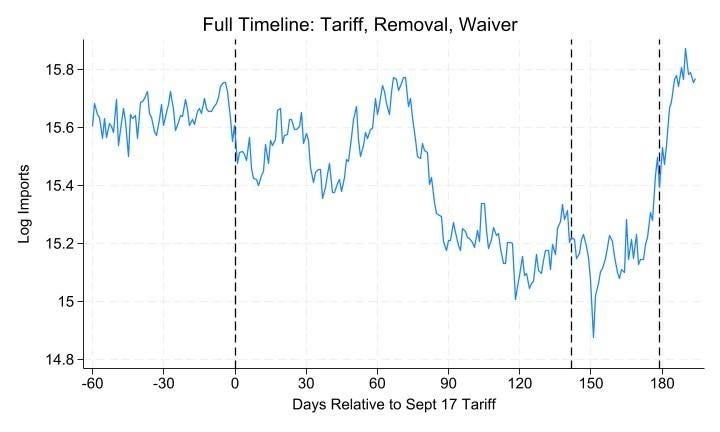
Around the time the tariff went into effect, Indian imports of Russian energy dropped by around 30% - this is the drop from 15.75 to 15.4. After a rebound a little over two months after the tariff, Indian imports at the cessation of the tariff stabilized at a point that was 39% lower than imports at the eve of the tariff taking effect. When an agreement between India and the U.S. was reached on Feb. 6, energy imports would stabilize at this point until the outbreak of the Iran War.
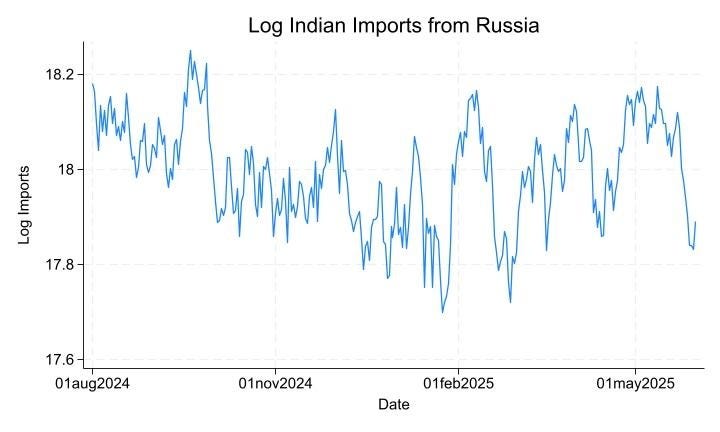
The complete event study demonstrates that the perception of progress in trade talks was more important than the tariff itself. If the tariff was the cause of reduced imports, they would not have rebounded while the policy was active. Expectations of a trade deal, contingent on a commitment from India to reduce Russian energy imports, were the driving factor of reductions. An analysis of Indian imports from August 2024 to May 2025 also demonstrates that the trade talks were significant and import fluctuations were not cyclical. The following graph shows this — during the same periods a year prior, imports cycled around a baseline that did not shift as much as it did during the 2025-26 trade talks.
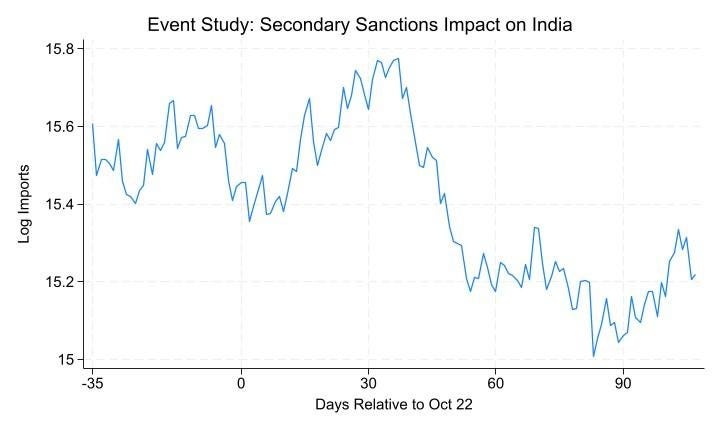
On Oct. 22, the U.S. imposed another sanction that affected India. These were total sanctions on firms that traded with Russian oil companies Rosneft and Lukoil. Vrinda Sahai, a research analyst at the Carnegie Endowment’s India branch, claimed that these sanctions caused a greater reduction in Indian imports than the tariff. An event study centered around these sanctions shows that this was not the case on a large scale. In fact, these sanctions were followed by the rebounding of Indian imports in November and December. Once again, the possibility of a trade deal continued to be the determining factor in the reduction of Indian energy imports from Russia.
The closing of the Strait of Hormuz and its impact on global oil supply has provided another angle for analysis on the India-Russia energy relationship along with the ability of American policy to impact it. Following the outbreak of war, the U.S. issued a temporary sanctions waiver allowing firms to purchase Iranian and Russian energy without triggering secondary sanctions. The graph below is an event study outlining Russian energy exports to India centered around this waiver.
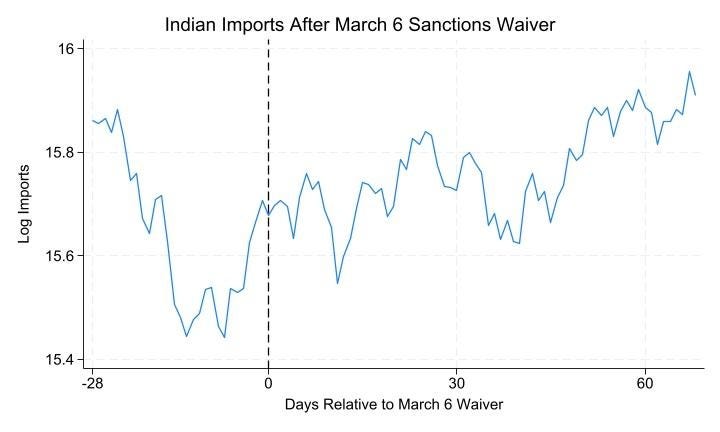
The graph shows a consistent increase in Russian imports following the waiver. The increase is even more pronounced when seen in the first complete event study graph above. What makes the rise in purchases significant is the fact that Russia is selling oil at a premium following the closure of the Strait as opposed to the discount it had given India following the outbreak of the Ukraine war. The Trump administration has claimed it will not renew the waiver after it is set to expire May 16, but it has already renewed the waiver once in mid-April while claiming the same. Punishing India during a time when the nation is already facing energy shortages due to the Hormuz closure will only be seen as a hostile move by the Indian government.
In the larger scheme, Operation Epic Fury has undone the progress made by Trump in getting India to reduce its purchases of Russian oil. The formal event study above analyzing the sanctions waiver once again demonstrates that U.S. economic pressure itself is not the primary determinant of Russian energy purchases. During the trade negotiations, the political pressure that came with tensions between the two nations was what drove energy imports down. Larger macroeconomic considerations are currently driving Russian energy imports upwards, and the Indian government is likely hedging in the expectation of further supply cuts.
The failure of American economic policy also warrants a reconsideration of sanctions on Russian energy as a foreign policy tool. The Indo-Russian energy relationship will likely continue due to the sheer size of Russia’s energy market and India’s massive energy needs. Policy cannot impact this relationship because of how entrenched it is. If Russia’s energy network is to be dismantled, it must be a primary policy, not a secondary policy aimed at targeting Russia’s war efforts. The U.S. must also provide a viable alternative for its allies, which depend on Russia’s massive reserves.
The views and information contained in this article are the author’s own and do not necessarily represent those of The Asia Cable.